040 East Meets Middle East
Tel Aviv’s love affair with Japanese culture continues to evolve. Over the past decade or so, sushi has become mainstream food in the city. So much so that in 2018, Tel Aviv was declared as the city with the highest number of sushi places per capita, more than any other city in the world apart from Tokyo. This romance has now become from a fling into a full blown long term relationship.
Enter Kimuraya - the Japanese chain restaurant operating in 150 locations in Japan and 11 in Dubai, has opened its new branch in Tel Aviv (on 3 Maze Street). After months of scouting, Kimuraya’s special envoy to Tel Aviv concluded: “Israel has a rich culture and an international community. Despite concerns about the security situation, I was very impressed by the resilience and positive attitude of the people here, which gave us the confidence to open.”
Tel Avivians are now able to enjoy a true izakaya-style restaurant. Once you step inside you will immediately feel immersed in the Japanese atmosphere. The culinary experience includes high-end saké for drinks and the special grilled beef called Yakiniku. The ultimate experience is something Tel Aviv hasn’t yet seen, that is the wagyu shabu shabu - raw meat served as a communal meal around a pot with boiling water filled with carefully selected herbs and vegetables. Diners will hopefully do their best to hold on to the meat with chopsticks and then dip it in the simmering pot for a moment to cook.
The Japanese invasion is felt in more speciality food places in Tel Aviv. Koko Neko in the Florentine neighbourhood is such a trendy ramen stand that people queue for more than an hour, just to get that comforting bowl of noodles. A chain of the Japanese version of ice cream - mochi - now has six branches in Tel Aviv, selling this sweet dessert made of rice dough. The recently-opened Asa restaurant, off Rothschild Boulevard, features Israel's first robata grill - a traditional Japanese charcoal grill that required special municipal approval to install and a hefty investment by a group of local restaurateurs.
One might dub this phenomenon as the second Japanese invasion. The first one was a couple of decades ago, as Israeli chefs sought to bring in this cuisine that was completely foreign back then. They had to fight bureaucratic battles with the Health Ministry to import soy sauce and seaweed - ingredients barely available in 1990s Israel. It’s possible that the second invasion started also because of El Al, the Israeli aviation company, which had launched its direct Tel Aviv-Tokyo route in March 2023, making Japan more accessible than ever and turning it into a hugely popular destination for Israelis. "Israelis who tasted authentic ramen in Tokyo or participated in a traditional tea ceremony come back with hunger for this experience at home," says Dr. Yoshi Higuchi, Japan's cultural attaché in Israel.
Matcha now appears on the shelves of common Israeli supermarkets. A pop-up matcha booth recently opened on Rothschild Boulevard, in what used to be the first kiosk in Tel Aviv. How amazing it is, that the first business place in the city, originally selling light beverages, now sells a Japanese drink made of green tea powder. It really goes to show how close the Far East had become to the Middle East.
Now a matcha bar. The first kiosk in Tel Aviv
I was thinking about the second Japanese invasion of Tel Aviv as I was passing by Oomai on Rothschild Boulevard. Positioned at the corner of Yavne Street, it has become a neighborhood fixture serving pre-made sushi sandwiches and imported Japanese soft drinks and snacks. Tel Aviv's evolving food scene is yet another example of how locals lovingly adopt international culture.
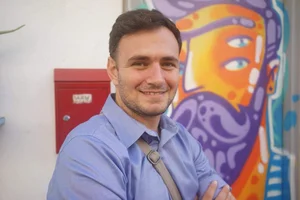
My name is Tomer Chelouche and I've been guiding tours in Tel Aviv since 2008. I started out of fascination with my family history - the Chelouche family was one of the founding families of Tel Aviv. My ancestors built this city - and I'm telling its story.
The best way to get to know Tel Aviv better is by purchasing one of my audio tours. Here's one way to experience it -
My "Trail of Independence" audio tour is a historical walk that follows a section of Rothschild Boulevard, tracing the origins of modern Tel Aviv. By walking in the footsteps of founders like David Ben-Gurion and Meir Dizengoff, you’ll get to know not one, but two stories - how Tel Aviv was born and how Israeli Independence was achieved.
The tour reveals the incredible story of the first Jewish city in the world, founded in 1909, which transformed in recent years into the heart of the Startup Nation. You'll discover the secrets behind the preserved houses, including the Hall of Independence - where the State of Israel was declared in 1948 - as well as the Hagana Museum - where the Israeli army started to take shape.
One stop along this route is that kiosk I mentioned - now serving matcha. The audio tour explains how Tel Aviv was planned as a green, quiet suburb of Jaffa, with strict prohibitions against opening businesses, in order to ensure peace and tranquility. The first Tel Avivians did allow one kiosk owner to open up shop here. Little did he know that, instead of selling cold drinks to sun-scorched pioneers, staff at the kiosk would one day hand out Japanese beverages.
The building facing the kiosk, at 9 Rothschild Boulevard, used to be my great-great-grandfather's house. My grandfather told me how as a child he'd return from school, buy a soda at the kiosk, and visit his grandfather in that house. You’ll hear more from my family stories in this audio tour.
Now a matcha bar. The first kiosk in Tel Aviv on the backdrop of 9 Rothschild Boulevard
You can make sure you've downloaded my Trail of Independence audio tour before you head out, or you can download it on the go if you're set with a data package allowing for uninterrupted internet access. There's a link in the show notes to purchase my audio tour -
The Trail of Independence: Tracing the origins of modern Tel Aviv
If you have any questions - you’ll find all the ways to contact me on telaviv.tours (telaviv as one word, no space, no hyphen) and there’s a link in the show notes for your digital convenience.
This tour route passes through the heart of where Israeli independence was proclaimed, and it's worth reflecting on the words of Israel's Declaration of Independence, read aloud in that very Hall of Independence on May 14, 1948: "The State of Israel will maintain complete equality of social and political rights for all its citizens regardless of religion, race, or gender; it will guarantee freedom of religion, conscience, language, education, and culture; it will safeguard the holy places of all religions… We call upon the Arab inhabitants of the State of Israel to preserve peace and participate in building the state on the basis of full and equal citizenship…"
Entrance to Mahmoudia Mosque in Jaffa
These founding principles established Israel as the only democracy in the Middle East, guaranteeing equal rights to all citizens regardless of background. Traveling to Israel today, you witness this diversity in action - as of 2025, Israel's population of approximately 10 million includes almost 8 million Jews (~78%) and about 2 million non-Jewish citizens (~21%). Non-Jewish population comprises of Muslim Arabs, Bedouins, Christians, Druze, to name just the largest minority groups, of which there are more.
Muslim Arabs constitute the largest minority group at approximately 1.8 million people (18.1% of the population), predominantly Sunni, living in mixed cities like Jaffa, Haifa, and Lod, as well as Arab towns and villages, mostly throughout the Galilee - that’s Israel’s North. The Bedouin community, numbering roughly 200,000 and included within the Muslim population, has largely transitioned from nomadic shepherd life to permanently settled society, primarily in the Negev desert, in Israel’s South, maintaining tribal traditions while increasingly entering Israel's labor force and higher education.
Educationally and economically, disparities persist - Israel's Arab community constitutes mainly a working-class sector in a middle-class society. Arabic serves as Israel's second official language alongside Hebrew, with separate Arabic-language school systems, media, and cultural institutions maintaining distinct Arab identity. Muslim Arabs hold full Israeli citizenship with equal political and civil rights, voting in elections and serving in the Knesset. They are, however, exempted from mandatory military service due to concerns about dual loyalties during armed conflicts - a policy some view as protective while others consider exclusionary.
Christians number approximately 190,000 (1.9%), concentrated particularly in Nazareth, Haifa, and Jerusalem, with dozens of denominations represented from Greek Orthodox and Greek Catholic (the two largest groups) to Roman Catholic, Maronite, Armenian, and various Protestant communities. Christian Arabs have emerged as Israel's most educated demographic, attaining bachelor's and academic degrees at higher rates than Jews, Druze, or Muslims, and maintaining fertility rates of just 1.7 children per woman - the lowest of any group.
The Druze community, numbering approximately 152,000 (1.6%), practices a distinct secretive monotheistic faith founded in the 11th century. Druze reside primarily in several villages in northern Israel. Since 1957, at their community leaders' request, Israeli law has mandated military service for Druze men, creating a special bond with Israeli society. This is what distinguishes them from other Arab speaking citizens and has fostered closer integration with Israeli Jewish society while maintaining distinct cultural and religious identity.
This episode airs just a few days before November 30th, 2025. This is when Israel's education system observes a day of commemoration for the departure and expulsion of Jews from Arab Countries and Iran. This date marks a painful historical reality that contextualizes Israel's democratic commitments: while Israel established itself as a democracy guaranteeing equal rights to minorities, Jews throughout the Arab and Muslim world faced systematic persecution and forced expulsion after 1948. Almost one million Jews were driven out of countries where their communities had thrived for centuries, including Iraq, Iran, Yemen, Egypt, Libya, Syria, Lebanon, Morocco, Tunisia and Algeria. Ancient Jewish communities that predated Islam by centuries were uprooted, their properties confiscated, their cultural heritage erased.
The contrast remains stark. In completely autocratic regimes across the Middle East, Jewish populations that numbered in the hundreds of thousands have dwindled to handfuls or disappeared entirely. Meanwhile, Israel's Arab citizens vote in free elections, serve in parliament, sit on the Supreme Court, and contribute to every aspect of Israeli society. Walking through Tel Aviv, eating at that Japanese restaurant or sipping matcha at the historic first kiosk, you're experiencing a city and a country built on liberal principles that remain revolutionary in this region - the radical notion that all citizens, regardless of religion or ethnicity, deserve equal rights and opportunities. The Trail of Independence doesn't just trace Tel Aviv's physical origins; it illuminates the ideals that continue shaping Israel's complex, imperfect, but genuinely democratic character.
Thanks for listening and you’ll hear from me again when the next episode comes out next week.Until then - I am Tel Aviv tour guide Tomer Chelouche, signing off and hoping to see you soon in Tel Aviv.