041 City Of Grace
"We will not be silent. We are not going anywhere. We may be few, but we're huge in 'chutzpah'." With these words, Debra Messing accepted her honorary award at the closing ceremony of TLVFest, Tel Aviv's International LGBTQ+ Film Festival, last month. The Emmy-winning actress, best known for her iconic role as Grace Adler in "Will & Grace," had traveled from New York specifically to receive this recognition - but her visit represented something far more significant than a ceremonial appearance.
Messing's presence in Tel Aviv marks a rare convergence of two vital advocacy movements. For three decades, she has championed LGBTQ+ rights, beginning with her groundbreaking portrayal of a Jewish woman living with her gay best friend in a sitcom that reshaped public attitudes. Since October 7th, she has emerged as one of Hollywood's most vocal supporters of Israel, often at considerable personal cost. At a moment when many public figures choose silence, Messing has chosen to speak - and more importantly, to show up.
Her week-long stay at the Setai Hotel's presidential suite - 120 square meters of luxury with panoramic Mediterranean views and two sun terraces - became more than just accommodation. From those windows overlooking the sea, Messing could see the city she had praised to Mayor Ron Huldai during their meeting at City Hall: "Tel Aviv is a beautiful, vibrant, gorgeous city." The mayor, presenting her with the Key to the City, joked that it doesn't always work. Messing's response captured both her humor and genuine affection: "I'd love to come back and act here. I'm learning Hebrew. I'll take this as an invitation to move here."
The significance of that Key to the City ceremony extends beyond the ceremonial. "In a time when many are silent," according to Mayor Huldai, "she chose to make her voice clear and sharp for Israel and for universal values of justice, freedom and humanity." The gesture carries particular weight given Tel Aviv's unique position as the only major city in the Middle East where LGBTQ+ individuals genuinely feel that they can live openly and safely.
This reality creates a natural alliance between Israel advocacy and LGBTQ+ rights - one that has become increasingly fraught in the wake of October 7th. Messing's willingness to bridge these communities represents a form of moral clarity that has become increasingly rare in contemporary progressive spaces.
At the festival's closing ceremony, surrounded by Tel Aviv's vibrant LGBTQ+ community, Messing spoke about losing her beloved theater professor to AIDS at age 41 - a loss that transformed her into a lifelong advocate. "He taught us that we always have to do something, especially the things that scare us," she recalled. That lesson seems to have guided her through the past two years of professional isolation and personal attacks for her Israel advocacy.
A presidential suite with panoramic views. The Setai Hotel in Jaffa by the Jaffa Clock Tower
Walking past the Setai Hotel in Jaffa, I imagined Messing looking out from that presidential suite's panoramic windows at the Mediterranean below. Her week-long stay bore witness to a city that refuses to stop being vibrant, even in difficult times. Her parting remark - "I'll take this as an invitation to move here" - might have been delivered with a smile, but it captured Tel Aviv's magnetic pull on those who choose to stand with it.
My name is Tomer Chelouche and I've been guiding tours in Tel Aviv since 2008. I started out of fascination with my family history - the Chelouche family was one of the founding families of Tel Aviv. My ancestors built this city - and I'm telling its story.
The best way to get to know Tel Aviv better is by purchasing one of my audio tours. Here's one way to experience it -
My "Old Jaffa" audio tour starts right beside the Jaffa Clock Tower, just a short walk from the Jojo Hotel on Salame Road. This guesthouse occupies a preserved Bauhaus building where exposed walls reveal a century of Tel Aviv's history - including traces of vintage Popeye wallpaper from decades past. The eight cozy rooms blend vintage character with modern comfort, featuring custom-made furniture and spacious showers. Two rooms include balconies overlooking Jaffa's vibrant streets.
What sets Jojo apart is its communal lounge, designed for connection rather than formal hotel distance. The fully equipped kitchen, comfortable seating areas, and intimate courtyard create spaces where travelers naturally meet and share experiences. The staff goes beyond basic hospitality, connecting guests to the best breakfast spots, hippest bars, and most interesting tours in the area. While the building has no elevator, the rooms are only sixteen steps up on the first floor, and staff happily assist with luggage.
After enjoying Jojo's welcoming atmosphere, you'll be perfectly positioned to start my Old Jaffa audio tour. The walk begins near the Jaffa Clock Tower and takes you through four thousand years of history compressed into Old Jaffa's compact hillside. In summer, I recommend starting no later than 10am to avoid the heat, but during these winter-ish days you can begin in the late morning hours. This hour-long route weaves through ancient alleyways where you'll follow the footsteps of Alexander the Great, the Crusaders, and Napoleon Bonaparte.
My narration will guide you beside beautifully restored stone buildings that now house galleries and workshops in the Artists' Quarter. As you climb toward the highest point in Old Jaffa, I'll share how archaeological findings dating back to the pharaohs were discovered in these very gardens where you're walking. You'll decipher symbols on St. Peter's Church, make a wish on the Wishing Bridge while overlooking the Mediterranean and see Andromeda's Rocks where Greek mythology intersects with Jaffa's ancient coastline.
The suspended orange tree is another stop in this audio tour - a tree somehow still living and growing despite being completely uprooted. Along the way, you'll hear my stories of how my family, the Chelouche family, helped modernize Jaffa, adding personal history to the layers of imperial rule that shaped this ancient port city.
The tour's almost-circular route brings you back near your starting point on Yefet Street, where the vibrant energy of Jaffa's Flea Market area beckons. From there, you can easily return to Jojo Hotel, perhaps stopping at the lounge to share stories of your walk with fellow travelers over a drink.
You can make sure you've downloaded my Old Jaffa audio tour before you head out, or you can download it on the go if you're set with a data package allowing for uninterrupted internet access. There's a link in the show notes to purchase my audio tour -
Old Jaffa's Secrets: A Circular Tour from the Clock Tower to Yefet Street
If you have any questions - you’ll find all the ways to contact me on telaviv.tours (telaviv as one word, no space, no hyphen) and there’s a link in the show notes for your digital convenience.
Travellers to Israel this January 2026 will enjoy mild winter weather, perfect for exploring the northern regions of the country. Average temperatures range between 8-16 degrees celsius (that's about 45 to 60 Fahrenheit) - pleasantly cool compared to the summer heat, with occasional rain showers that turn the Galilee landscape lush and green. While Tel Aviv's beaches feel too chilly for swimming, the North offers dramatic scenery and fascinating history that shine brightest during winter months.
The Golan Heights tower over the northeastern corner of Israel, offering panoramic views across Syria with the hopes that one day, sooner rather than later, it will be possible to cross this border peacefully. Mount Hermon, Israel's highest peak at ~2,800 meters (more than 9,000 feet), becomes the country's only ski resort during winter. January typically brings the best snow conditions, attracting Israeli families who otherwise travel abroad for winter sports. Even if skiing isn't your interest, the cable car ride provides beautiful views of snow-covered peaks on the background of green valleys further away. The Golan's volcanic landscape includes nature reserves and waterfalls that flow strongest after winter rains. It’s also the cowboy countryside of Israel with numerous ranches and an area rich with wineries producing some of Israel's finest bottles - definitely worth a visit.
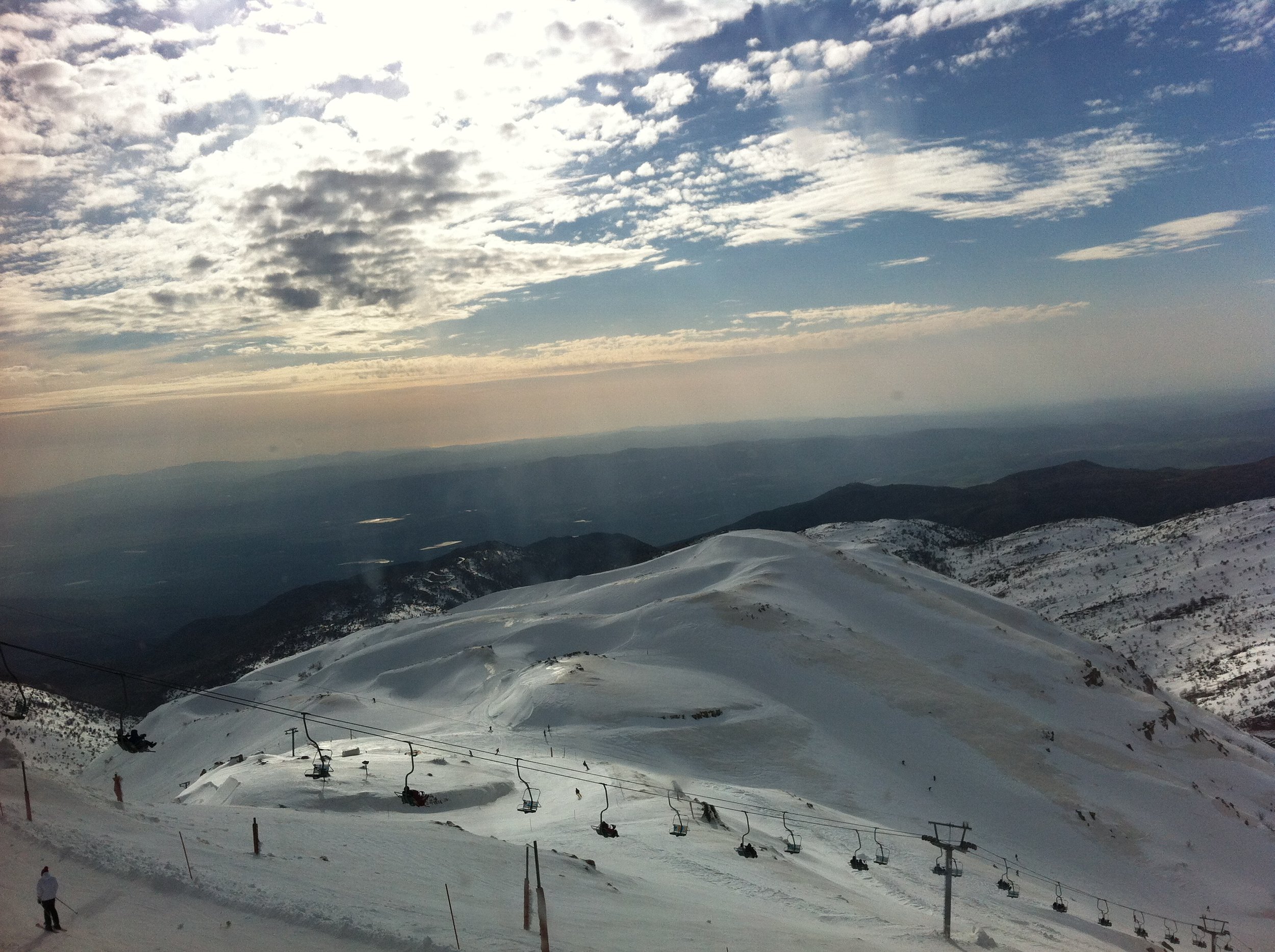
On the Northeastern corner of Israel, bordering Syria. Snow-covered mount Hermon
Mount Meron rises as the highest peak in the Galilee region, surrounded by hiking trails through Mediterranean forests. The nearby city of Safed, perched at 900 meters elevation, ranks among Judaism's four holy cities alongside Jerusalem, Hebron and Tiberias. Safed's narrow cobblestone alleys wind between ancient synagogues and artists' galleries, where Kabbalists developed Jewish mysticism during the 16th century. The city's cool January temperatures and frequent morning mists create an atmospheric setting for exploring its spiritual heritage and traditional Jewish art scene.
Nazareth, the largest Arab city in Israel, draws Christian pilgrims to the Basilica of the Annunciation, built over the grotto where tradition holds the angel Gabriel appeared to Mary. The city's markets overflow with Middle Eastern spices, sweets and handicrafts, while its restaurants serve some of the region's best Arabic cuisine. Just outside Nazareth, the dome-shaped Mount Tabor rises from the Jezreel Valley. Christian tradition identifies this as the site of Jesus's transfiguration, commemorated by the Franciscan Church of the Transfiguration at Mount Tabor’s summit. The valley below, dotted with Kibutzim and other agricultural settlements, is considered “the grain barn of Israel”.
Coastal Promenade near Tiberias
The Sea of Galilee is another site linked to the story of Jesus. January rainfall raises the lake’s water level, but please don’t try to walk on water… January's cooler temperatures make hiking the trails around the lake particularly pleasant. Note that the lake's shores hold significance for Christian pilgrimage. The lakeside city of Tiberias is kind of a resort city, but not at its peak nowadays, so I’d recommend skipping it.
The city of Haifa cascades down the slopes of Mount Carmel. It is Israel's third most populated city (after Jerusalem and Tel Aviv) and takes pride in peacefully blending different religious groups. The Bahá'í Gardens, a UNESCO World Heritage site, descend the mountainside in perfectly manicured terraces surrounding a golden-domed shrine. January's mild weather makes the steep garden paths manageable, with views extending across the Haifa Bay, which is usually filled with huge vessels waiting to anchor at the Haifa Port. Mount Carmel itself offers nature reserves and the Stella Maris Monastery, while Haifa's German Colony neighborhood features restored Templar buildings now housing cafes and restaurants. If you’re a city-lover with extended time to travel Israel - Haifa is a great destination to visit. I also recommend dropping by the Talpiot Market at the city center, where you can taste the local cuisine, though locals go there for the Indian and Thai restaurants.
Third most populated city in Israel. Haifa cascades down the slopes of Mount Carmel
Acre, known in Hebrew as Akko, preserves one of the world's best-maintained Crusader cities. Underground halls and tunnels from the period European Knights came to capture the Holy Land lie beneath the Ottoman-era city, creating layers of history spanning a thousand years. The port city's markets, Turkish bathhouse and stone walls by the seashore transport visitors to the Middle Ages. January brings fewer crowds than summer months, allowing more intimate exploration of the ancient alleyways, including the local market famous for the local Arab eateries as well as sea food restaurants. The northern coastal plain beyond Acre features the Rosh Hanikra grottos, where Mediterranean waves carved caves into white chalk cliffs at Israel's border with Lebanon. It’s worth the trip if you’re a nature fan with a special interest in geology.
Northern Israel's compact geography allows visiting multiple regions in a few days, with drives between destinations rarely exceeding an hour. I’ll continue with my recommendations of other areas in Israel to explore in the next episode.
Thanks for listening and you’ll hear from me again when the next episode comes out next week.Until then - I am Tel Aviv tour guide Tomer Chelouche, signing off and hoping to see you soon in Tel Aviv.